




Summer of Clearinghouses
Everyone seems to have announced a clearinghouse over the past few weeks. We did too. Ours is called Athena, and the main thing that sets it apart is that it was already real and running when we announced it —
Cybersecurity researchers have flagged a new ransomware family called GodDamn that employs the PoisonX kernel driver to neutralize security software as part of its defense evasion strategy. According to a new report published by the Threat Hunter Team from Symantec,
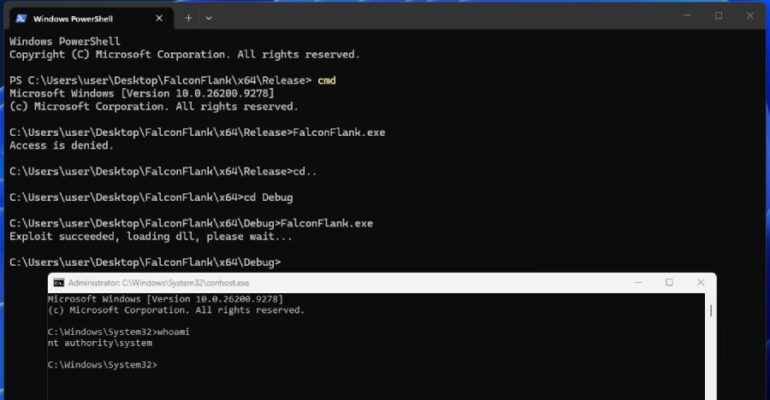
Microsoft has released security updates for a Defender vulnerability known as RoguePlanet, nearly a month after details of the flaw became public. The vulnerability, tracked as CVE-2026-50656 (CVSS score: 7.8), is a privilege escalation issue in the Microsoft Malware Protection
Meta has announced that its new artificial intelligence (AI) model Muse Image lets people use public Instagram posts and reels to generate AI content, and it’s enabled by default. “You can also @-mention Instagram accounts in the Meta AI app
Ask an AI coding agent to scan open-source code for security holes, and it might run the attacker’s code on your own machine instead. That is the finding in a proof-of-concept published Wednesday by the AI Now Institute, an attack it calls
Researchers at Wiz found that a flaw in six popular AI coding assistants lets a booby-trapped code project quietly take control of a developer’s computer. The assistant asks permission to edit one harmless-looking file, but the write lands on a sensitive one
Cybersecurity researchers have disclosed details of a new threat actor dubbed Lurking Lizard that has been operating an end-to-end malicious residential proxy business using an infrastructure comprising more than 230 lookalike domains. The activity dates back to at least August
Sophos looked at a week of its own endpoint data and found that AI coding agents such as Claude Code, Cursor, and OpenAI Codex are setting off detection rules written to catch human intruders. The agents are not malicious. They
AI coding assistants have a habit of making things up. Ask one to fetch a popular tool, and it will sometimes hand back a real-sounding name for a project that does not exist. New research, which its authors call HalluSquatting, turns
Ubiquiti has shipped updates to address multiple critical security flaws impacting UniFi Connect, UniFi Talk, UniFi Access, UniFi Protect, and UniFi OS that could result in privilege escalation and arbitrary command execution. The list of vulnerabilities is as follows –